Question 1: Collodion process and the creation of ambrotypes and tintypes
After reviewing and reading through the material posted on photography, the work of Frederick Archer stood out and appealed greatly to me. His technique pushed the art of photography forward substantially and opened a whole new world of possibilities. It is hard to fathom images and photography to the extent we have today without this leap in technique and technology. Essentially Archer set the stage for portable cameras; he invented the first collodion process which drastically reduced the time needed for a photograph to be imprinted on the chosen material.
This process consisted of coating the chosen material with iodine compounds and cleaning it in silver nitrate. When the plate is wet, its exposed to the sunlight and thus starts imprinting the picture. This gave photographers the chance to work out in the field by using a darkroom out in the field to process the photographs. The method was adopted worldwide soon after, completely overtaking daguerreotypes and calotypes because of its effectiveness. A dry version of this technique was also developed as the photographer was limited by having to produce the picture when the plate is wet. This version took longer to implement on the plate and was ill suited for portraits due to the amount of movement done by a person but worked well for portraying landscapes and bigger pictures where the exact moment is not as important.
Frederick’s work gave leeway to new techniques, and two prominent ones that arose with his research were ambrotypes and tintypes. The ambrotype was created and licenced by James Ambrose Cutting and relied on using the collodion process on top of a sheet of glass to produce a negative image. Using this technique over a dark background (for example using black paint or paper) yielded photographs of an impressive quality, which was much more accessible and usable due to being portable. The tintype was another version of the ambrotype; instead of utilizing a glass plate the photographer would instead use a thin plate of iron.
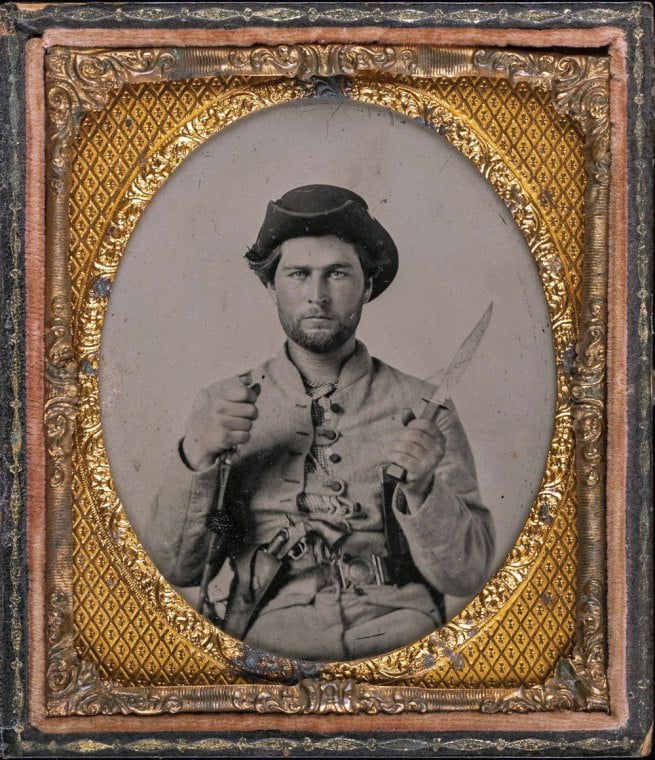
Example of an ambrotype
Without Fredericks discoveries the accessibility of cameras and pictures would have remained scarce, and we would not have access to the wide variety of photographs from the 1850’s and onwards that we have today. The newfound flexibility of the camera meant that photographers could start studying more than just the means of how to properly imprint pictures; they could start studying angles, scenes and compositions. Even though more efficient techniques were to come, in my opinion this discovery gave the art of photography room to breathe; to let photographers start playing more around with other aspects than the technical ones in a much larger degree.
In conclusion, photography has grown to become an important part of our lives and modern society; with social media growing and cameras being available for almost everyone, taking pictures and sharing moments have become an integral part of day-to-day life for many people. I think it can not be overstated how the accessibility of cameras and photography has impacted the world and the techniques mentioned in this report are the origins of portable photography.
Sources:
https://www.pbs.org/wgbh/americanexperience/features/eastman-wet-plate-photography/
 Linnea's blog